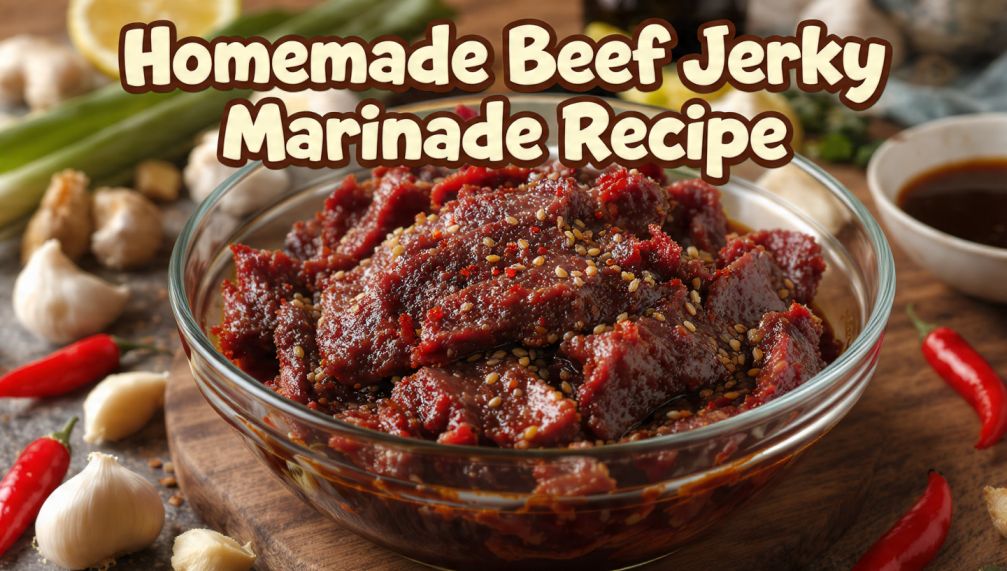
Prep Time: 30 minutes | Marinating Time: 12-24 hours | Drying Time: 4-8 hours | Yield: 8-10 oz jerky | Difficulty: Easy
Why Make Beef Jerky at Home?
Before we dive into the recipe, let me convince you why homemade jerky is absolutely worth your time.
Cost Savings
Have you looked at jerky prices lately? Premium beef jerky can cost anywhere from $30 to $50 per pound at the store. When you make it at home, you’re looking at roughly $8-12 per pound of finished jerky, depending on the cut of meat you choose. That’s a savings of 60-75%!
Let me break down the math:
- 2 lbs of beef round roast: approximately $12-16
- Marinade ingredients: approximately $2-3
- Total cost for ~10 oz jerky: $14-19
- Equivalent store-bought jerky: $25-35
Complete Ingredient Control
Store-bought jerky often contains:
- Excessive sodium
- Artificial preservatives
- MSG
- High fructose corn syrup
- Nitrates and nitrites
- Artificial flavors and colors
When you make jerky at home, you know exactly what goes into it. You can reduce sodium, use organic ingredients, avoid allergens, and skip all those unpronounceable additives.
Customizable Flavors
Love it spicy? Add more heat. Prefer sweet and savory? Adjust the sugar. Want unique flavors like coffee-rubbed or maple bourbon? Go for it! The possibilities are truly endless when you’re in control.
Freshness Factor
Homemade jerky, made with quality ingredients and consumed within a few weeks, simply tastes better than jerky that’s been sitting on a store shelf for months.
It’s a Fun Skill to Have
There’s something deeply satisfying about mastering this ancient preservation technique. It connects you to generations of people who’ve been drying meat for thousands of years.
The Classic Beef Jerky Marinade
After years of testing and refinement, this is my go-to marinade. It’s perfectly balanced between sweet, salty, savory, and just a hint of heat.
Ingredients
For 2 pounds of sliced beef:
Base Marinade
| Ingredient | Amount | Purpose |
|---|---|---|
| Soy Sauce | 1/2 cup | Salt, umami, preservation |
| Worcestershire Sauce | 1/4 cup | Complexity, tanginess |
| Brown Sugar | 2 tablespoons | Sweetness, Maillard reaction |
| Water | 2 tablespoons | Helps dissolve and distribute |
Aromatics & Spices
| Ingredient | Amount | Purpose |
|---|---|---|
| Garlic Powder | 1 teaspoon | Savory depth |
| Onion Powder | 1 teaspoon | Sweetness, complexity |
| Black Pepper | 1 teaspoon | Heat, flavor |
| Smoked Paprika | 1 teaspoon | Color, smokiness |
Optional Flavor Enhancers
| Ingredient | Amount | Purpose |
|---|---|---|
| Liquid Smoke | 1 teaspoon | Campfire smokiness |
| Red Pepper Flakes | 1/2 teaspoon | Heat |
| Curing Salt (Prague Powder #1) | 1/4 teaspoon | Color, preservation, safety |
Ingredient Deep Dive
Soy Sauce
The backbone of this marinade. Use regular soy sauce, not low-sodium (we need the salt for preservation). Tamari works great for a gluten-free option. For more complex flavor, try mixing half regular soy sauce and half dark soy sauce.
Worcestershire Sauce
This fermented sauce adds incredible depth—tanginess, slight sweetness, and umami. It contains anchovies, so use a vegan alternative if needed.
Brown Sugar
The molasses in brown sugar contributes to both flavor and color. Dark brown sugar gives a deeper, more caramelized flavor. You can substitute:
- Coconut sugar (1:1)
- Honey (1.5 tablespoons)
- Maple syrup (1.5 tablespoons)
Garlic and Onion Powder
Fresh garlic and onion can burn during drying and create bitter spots. Powdered versions distribute evenly and provide consistent flavor.
Smoked Paprika
This is my secret weapon. It adds beautiful color and smoky notes. Regular paprika works but lacks the smoke flavor.
Liquid Smoke
A controversial ingredient—some love it, some hate it. It’s made from actual smoke condensed into liquid form. Start with 1/2 teaspoon if you’re unsure, and adjust to taste.
Curing Salt (Optional)
Prague Powder #1 (also called pink curing salt or Instacure #1) contains 6.25% sodium nitrite. It:
- Inhibits botulism bacteria
- Preserves the pink/red color of the meat
- Adds a characteristic “cured” flavor
Important: Curing salt is optional for home jerky that will be stored properly and consumed within 1-2 weeks. If you’re giving jerky as gifts, shipping it, or storing long-term, curing salt adds an extra layer of safety.
Step-by-Step Instructions
Now let’s bring it all together. Follow these steps for perfect jerky every time.
Step 1: Prepare Your Workspace
Before handling raw meat, set yourself up for success:
- Clear and clean your counter space
- Set out all ingredients and measure them
- Have paper towels ready
- Get your zip-lock bags or marinating container
- Clean your knife and cutting board
Step 2: Prepare the Meat (15-20 minutes)
- Trim the Fat: Remove all visible external fat and any thick pieces of fat or silver skin within the meat. Fat doesn’t dry properly and will cause your jerky to spoil faster.
- Partially Freeze: If not already done, place the meat in the freezer for 1-2 hours until firm but not solid.
- Slice the Meat: Following the slicing guide above, cut your meat into even strips. Aim for 1/8 to 1/4 inch thickness.
- Inspect Your Slices: Look over each piece and trim any fat you missed. Remove any pieces that are significantly thicker or thinner than the others (save for a separate batch or different use).
Step 3: Make the Marinade (5 minutes)
- Combine Wet Ingredients: In a medium bowl, mix the soy sauce, Worcestershire sauce, and water.
- Add Sugar: Whisk in the brown sugar until completely dissolved.
- Add Spices: Stir in the garlic powder, onion powder, black pepper, and smoked paprika.
- Add Optional Ingredients: If using, add the liquid smoke, red pepper flakes, and/or curing salt.
- Taste and Adjust: Dip a clean finger in the marinade and taste. It should taste slightly saltier and more intense than you want the final product—flavors mellow during drying.
Step 4: Marinate the Meat (12-24 hours)
- Combine Meat and Marinade: Place the sliced meat in a gallon zip-lock bag (or divide between two bags if needed). Pour the marinade over the meat.
- Remove Air: Squeeze out as much air as possible before sealing the bag.
- Massage: Massage the bag to ensure every piece of meat is coated with marinade.
- Refrigerate: Place the bag flat in the refrigerator. Put it on a plate or in a container to catch any potential leaks.
- Flip and Massage: Every few hours (or at least once), flip the bag and massage again to redistribute the marinade.
Marinating Time Guidelines:
- Minimum: 6 hours (flavors will be mild)
- Optimal: 12-24 hours (best flavor penetration)
- Maximum: 48 hours (meat may become too salty or mushy)
Step 5: Prepare for Drying (15-20 minutes)
This step is crucial for proper drying and texture.
- Remove from Marinade: Take the meat out of the bag and let excess marinade drip off.
- Pat Dry: This is important! Lay strips on paper towels and pat them thoroughly dry on both sides. Use fresh paper towels as needed. The drier the surface, the better the texture.
- Optional—Season: If you want extra flavor on the surface, now is the time to add additional pepper, spices, or a dry rub.
- Arrange for Drying: See specific instructions below for your chosen method.
Step 6A: Dehydrator Method (Recommended)
Setup:
- If your dehydrator has solid trays or liners, you can use them for the first hour to catch drips, then switch to mesh trays.
- Lightly spray trays with cooking spray for easier removal (optional).
- Arrange meat strips in a single layer with space between pieces—they should not touch or overlap.
Drying Process:
- First Hour at 165°F: This higher temperature kills surface bacteria (food safety step).
- Remaining Time at 160°F: Reduce temperature for the duration of drying.
- Rotate Trays: Every 2 hours, rotate tray positions (top to bottom, bottom to top) for even drying.
- Check Progress: Start checking for doneness after 4 hours.
Expected Timing:
- Thin slices (1/8″): 4-5 hours
- Medium slices (3/16″): 5-6 hours
- Thick slices (1/4″): 6-8 hours
Step 6B: Oven Method
Setup:
- Position oven racks in the upper-middle and lower-middle positions.
- Line baking sheets with aluminum foil (for easy cleanup).
- Place wire cooling racks on top of the baking sheets.
- Spray wire racks with cooking spray.
- Arrange meat strips in a single layer on the racks.
Drying Process:
- Preheat Oven: Set to 175°F, or your oven’s lowest setting.
- Prop Door Open: Use a wooden spoon to keep the oven door cracked about 2 inches. This allows moisture to escape. Note: This is essential—without it, humidity builds up and prevents proper drying.
- Flip and Rotate: Every 2 hours, flip the jerky pieces and rotate the baking sheets.
- Monitor Closely: Ovens can have hot spots, so watch for uneven drying.
Expected Timing:
- Thin slices: 4-6 hours
- Medium slices: 6-8 hours
- Thick slices: 8-10 hours
Step 6C: Smoker Method (For BBQ Enthusiasts)
For ultimate smoky flavor, you can make jerky in your smoker.
Setup:
- Set up your smoker for low heat (165-180°F).
- Use mild wood chips: apple, cherry, or hickory work well.
- Arrange meat on racks with space between pieces.
Drying Process:
- Maintain temperature between 165-180°F.
- Add wood chips for the first 2-3 hours only (too much smoke creates bitter flavor).
- Continue drying until done, 4-7 hours depending on thickness.
Step 7: Test for Doneness
This is where many people make mistakes. Under-dried jerky spoils quickly; over-dried jerky is too tough.
The Bend Test:
- Remove a piece from the dehydrator/oven.
- Let it cool for 5 minutes (warm jerky feels more pliable than it actually is).
- Bend the piece in half.
What You’re Looking For:
- ✅ Perfect: Bends and cracks on the surface, but doesn’t break in half. You should see white fibers (the dried meat fibers) when you bend it.
- ❌ Under-done: Bends easily without cracking, feels soft or wet, no visible fibers.
- ❌ Over-done: Snaps in half like a cracker, very brittle.
The Tear Test:
Try to tear a piece. Properly dried jerky will tear with some resistance, and the interior should look uniform in color and texture—not wet or red.
When in Doubt:
Dry it longer. You can always rehydrate jerky slightly by storing it with a piece of bread overnight, but you can’t un-spoil jerky that wasn’t dried enough.
Step 8: Conditioning (Important!)
This step is often skipped but is crucial for shelf-stable jerky.
- Cool Completely: Let jerky cool to room temperature (30-60 minutes).
- Condition: Place jerky loosely in a large glass jar or zip-lock bag. Seal and let sit at room temperature for 24-48 hours.
- Check for Moisture: Shake the container periodically. If you see any condensation on the inside of the container, the jerky needs more drying.
- Redistribute Moisture: The conditioning process allows any remaining moisture to distribute evenly throughout the pieces.
Step 9: Store Your Jerky
After conditioning, store your jerky properly to maximize freshness.
Short-Term Storage (1-2 weeks):
- Airtight container or zip-lock bag
- Room temperature in a cool, dark place
- Include a food-safe desiccant packet if desired
Medium-Term Storage (1-2 months):
- Airtight container or vacuum-sealed bag
- Refrigerator
- Include desiccant packet
Long-Term Storage (6+ months):
- Vacuum-sealed bags
- Freezer
- Label with date
Final Thoughts
Making beef jerky at home is a rewarding experience that saves money and tastes incredible. This classic marinade is just the starting point—feel free to experiment with your favorite flavors!
Happy jerky making!